The good thing about short-term temping is the down time. That is, unless sitting at a desk waiting for the phone to ring and otherwise trying not to jump out of the 6th story window with its spectacular view of the white brick cubical jungle across the street sounds boring to you. Luckily, there is the InT4Rweb. And on the IntT4Rweb... there is Filter Magazine.
Filter saved me from my death. At their media center, they have scores of songs and videos, many of which are available to download in MP3 format. It took me two hours just to build up my scrumptious playlist of new indie music and then another two hours of boredom-free listening. Because I spend most of my time listening to old school southern rock and mourning the generation I was mistakenly born-into, I was not aware that there are actually some very cool bands out there making sweet new music. This was quite the adventure for me.
My newly-found favorites:
Kristoffer Ragnstam, Beauty and Breakfast By the Mattress
Emily Haines, Doctor Blind
Dustin O'Halloran, Opus 23
Pablo, Loser Crew
And now comes the ever-wonderful getting to know you parade of repeat listening until I know every note and pause by heart. There's nothing like new music discoveries. I guess I'm going to have to give this whole indie rock thing a chance. (Fret not Allman Brothers... you're still my first loves.)
Accidental Awesomeness
This weekend was a delightful stumbling into awesome new music.While I was supposed to attend the tree-decorating party of a complete stranger, I decided to forego the festivities and take a chance on a show at the Knitting Factory at the last minute. The band of my friend's drum teacher, Plus/Minus, was on the New York leg of their last tour (they are breaking up after new years) and so we hit it up.
ready to rock on the subway ride to the Knitting Factory.
 Fortunately for us, we got there about two hours early, enough time to drink many beers and catch opener "The Changes," who put on a fabulous live show. Slinky guitar parts, crisp vocals and talented musicians who switched up the instrumentation on almost every song kept me on my toes and loving it. Highlights: the vocalist keeping time by tapping a snare drum with a maraca and a very yummy guitarist/keys player/vocalist.
'Twas a great way to rev up for the salacious Plus/Minus, who took to the stage donning their own personal apron-clad camera crew. I guess the final tour for these guys will be one to remember. They opened with a clarinet part that set the mood for musical bounty and they continued to deliver throughout the set. The vocals were shadowy and smooth, offering the right amount of sweetness to the electrical array. Spot-on drum deliciousness and funky rhythmic moments kept the audience rockin' along, my self happily included.
We managed to lavish praise on drummer Chris Deaner following the show and scored some free +/- buttons. Too bad their New Year's Eve show is sold out!
After the show we pumped it up for some delicious Framboise and drunken debauchery at d.b.a.
Good Music always = Good Fun.
Check 'em out:
Plus/Minus Website
The Changes Website
0
comments
 Tuesday, December 05, 2006

Tuesday, December 05, 2006
Digging the Decemberists
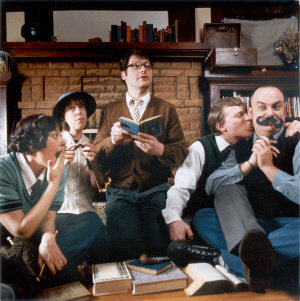
I resisted The Decemberists for awhile because of their seeming Brit-pop hipster-ness. While they may be the quintessential indie rock type hipsters flock to, they are, in fact, from Portland, Oregon. So I have to give them a chance. And they are, in fact, exceptionally good. So good, in fact, that I am sitting here listening to Castaways and Cutouts on repeat.
There's something mythical about their songs- strange, vague characters, somewhere old world and faraway. Their sound is a subtle mix of ethnic flavor (Irish, Eastern European, maybe?) with a strong folksy rock base. Colin Meloy's clear voice carries over the music smoothly, sometimes with unexpected vocal turns. They're enchanting and theatrical and still, somehow, completely uncomplicated. Those are my impressions. I dig it.
0
comments
Wednesday, November 15, 2006
Wednesday, November 15, 2006
let's start at the very beginning
the blues.
Not the very beginning, but a very good place to start, nonetheless.
The Blues are like a room you walk into in the dark. You have to hunker down for a while and let your eyes adjust. They may start out as strange and sinister forms, unidentifiable and unfriendly, but if you sit with them long enough clarity crystalizes. I've been sitting in that room for over a year now and I am starting to sense that there is light present.
The voices keeping me company tonight are straight out of jailbirds, vagabonds and voices of the 1939 South. An eerie miracle of ancient modernity and present routine allows me access to a trove of musical treasure: the John and Ruby Lomax 1939 Southern States Recording Trip. More like the beginnings of blues, which have and will go on as long as we do, I think. Anywhere you have people you have life's pleasures and pains and there you have the blues.
It seems like this process really does take part in the blues tradition, where technological innovation allows for this music to spread to farther and farther reaches. First it was the railroad, then recording, now the internet. Who knows what musical masters will hear these old sounds and come up with something brand rockin' new. The last time this stuff was exploited there was a musical revolution.
Listening to the field hollers is a strange experience, because the notes come directly out of voices to whom these songs were handed down by those that sang them in the fields, under watch and whip. Maybe if they were broadcast on syndicated radio we might have an easier time remembering where this country was just over a century ago. In any case, I do believe the most heartbreaking beauty comes from the most backbreaking suffering. Just listen to the Spirituals.
Some Field Hollers:
Diamond Joe, performed by Charlie "Big Charlie" Butler
It's a beautifully clear recording of a beautifully crisp voice, simple and some kind of bittersweet. Bob Dylan covers this song with a more upbeat ring-a-round tempo, but I feel like this recording rings out with undecorated loneliness. After about four listens I fell in love with Big Charlie.
Got a Woman Up the Bayou, performed by Ross "Po' Chance" Williams
At first listen, this recording sounds like a call straight to Ray Charles. But I guess every old blues singer's got a woman somewhere he isn't. This could be a duet with a female voice... though Po' Chance takes care of it with his dead-on falsetto.
 Worry Blues, performed by W.S. "Jaybird" Harrison, Sylvester "Texas Stavin' Chain" Jones & Wallace "Stavin' Chain" Chains
I can't hear a word they're saying on this recording, but the trio is sweet music in itself. It sounds to me like a redemption song, but more likely it's a work song since it's listed under the field hollers and the verses keep good time for grinding an axe.
Stavin' Chain has got some serious missing teeth but it looks like the man can howl.
Some Blues:
Black Betty, performed by Rev. Mose "Clear Rock" Platt
The original.
Don't You Grieve, performed by Aunt Mollie McDonald
Not the familiar 12-bar, but a graceful lullabye blues.
If you spend some time with this collection, it makes the later stuff that much sweeter. Knowing just how bare blues can be and then how rich and malleable is to start to understand why they are so extraordinarily important... and just plain extraordinary.
Not the very beginning, but a very good place to start, nonetheless.
The Blues are like a room you walk into in the dark. You have to hunker down for a while and let your eyes adjust. They may start out as strange and sinister forms, unidentifiable and unfriendly, but if you sit with them long enough clarity crystalizes. I've been sitting in that room for over a year now and I am starting to sense that there is light present.
The voices keeping me company tonight are straight out of jailbirds, vagabonds and voices of the 1939 South. An eerie miracle of ancient modernity and present routine allows me access to a trove of musical treasure: the John and Ruby Lomax 1939 Southern States Recording Trip. More like the beginnings of blues, which have and will go on as long as we do, I think. Anywhere you have people you have life's pleasures and pains and there you have the blues.
It seems like this process really does take part in the blues tradition, where technological innovation allows for this music to spread to farther and farther reaches. First it was the railroad, then recording, now the internet. Who knows what musical masters will hear these old sounds and come up with something brand rockin' new. The last time this stuff was exploited there was a musical revolution.
Listening to the field hollers is a strange experience, because the notes come directly out of voices to whom these songs were handed down by those that sang them in the fields, under watch and whip. Maybe if they were broadcast on syndicated radio we might have an easier time remembering where this country was just over a century ago. In any case, I do believe the most heartbreaking beauty comes from the most backbreaking suffering. Just listen to the Spirituals.
Some Field Hollers:
Diamond Joe, performed by Charlie "Big Charlie" Butler
It's a beautifully clear recording of a beautifully crisp voice, simple and some kind of bittersweet. Bob Dylan covers this song with a more upbeat ring-a-round tempo, but I feel like this recording rings out with undecorated loneliness. After about four listens I fell in love with Big Charlie.
Got a Woman Up the Bayou, performed by Ross "Po' Chance" Williams
At first listen, this recording sounds like a call straight to Ray Charles. But I guess every old blues singer's got a woman somewhere he isn't. This could be a duet with a female voice... though Po' Chance takes care of it with his dead-on falsetto.
Worry Blues, performed by W.S. "Jaybird" Harrison, Sylvester "Texas Stavin' Chain" Jones & Wallace "Stavin' Chain" ChainsI can't hear a word they're saying on this recording, but the trio is sweet music in itself. It sounds to me like a redemption song, but more likely it's a work song since it's listed under the field hollers and the verses keep good time for grinding an axe.
Stavin' Chain has got some serious missing teeth but it looks like the man can howl.
Some Blues:
Black Betty, performed by Rev. Mose "Clear Rock" Platt
The original.
Don't You Grieve, performed by Aunt Mollie McDonald
Not the familiar 12-bar, but a graceful lullabye blues.
If you spend some time with this collection, it makes the later stuff that much sweeter. Knowing just how bare blues can be and then how rich and malleable is to start to understand why they are so extraordinarily important... and just plain extraordinary.
0
comments
Sunday, September 10, 2006
Sunday, September 10, 2006
Subscribe to:
Posts (Atom)